Last updated September 24, 2026
New windows and doors improve comfort, cut energy bills and add long-term value to your home. Sightline Windows & Doors Pompano Beach pairs proven product lines with our own installing crews for lasting performance - and a price we put in writing.
1. Choose your installer
The unit is half the job - the install is the other half. Our own background-checked crews measure, set, seal and insulate every opening, and they know the lines we quote inside and out because they install them every week.
2. Select the right products
Compare styles, materials and glass packages side by side until the fit is right for your rooms, your budget and your goals. The product-line comparison below is the place to start.
3. Prepare your home for install
Before install day we walk you through a short checklist - furniture pulled back, treatments down, a clear path to each opening - so install day is watch-it-happen, not scramble.
Compare the Lines We Quote
Every project is priced on the same lines, side by side - the price indicators below are relative, and your consultant shows exact numbers on your actual openings.
PGTThe line Florida homeowners arrive naming - the most Miami-Dade certifications in the industry$$$
- More Miami-Dade NOA certifications than any other line we quote
- WinGuard, EnergyVue and ClassicVue Max systems built for every wind zone
- 99% on-time delivery keeps your install date on the calendar
CGIThe heavyweight impact line$$$$$
- Large-missile impact ratings for the strictest wind zones
- Architectural-grade aluminum with commercial-depth frames
- The line we quote when protection is the whole point
CWSThe Florida value pick$$
- Vinyl systems built in Florida for Florida codes
- Strong energy packages at the friendliest price point
- The smart start for whole-home replacements on a budget
ESWSlim lines, big glass$$$$
- Narrow-sightline aluminum for modern elevations
- Oversized openings and floor-to-ceiling glass
- Impact-rated without the bunker look
ECOThe aluminum impact workhorse$$$
- Miami-built aluminum impact systems
- A strong price-to-protection ratio for coastal homes
- Proven inventory lines with short lead times
Windows & Doors Warning Signs: A Pompano Beach Homeowner’s Reference Guide
Condensation between double-pane glass panes is not a cosmetic problem. It means the insulating gas has escaped and the sealed unit has failed, which in Pompano Beach’s heat load means your HVAC system is compensating for a thermal opening equivalent to leaving that window cracked three-eighths of an inch year-round. Most homeowners in neighborhoods like Garden Isles, Harbor Village, and the eastern beachside corridors don’t recognize the early failure signs until the wall assembly behind the frame has already absorbed enough moisture to require remediation. This guide-along with The Complete Guide to Windows & Doors in Pompano Beach-identifies each warning sign at the stage where intervention is still inexpensive, before visible water staining or frame buckling appears.
Quick Answer

The critical warning signs of window and door failure in Pompano Beach include: condensation between glass panes indicating seal failure; visible light through closed weatherstripping gaps detectable by the dollar-bill drag test; frame corner joint separation visible at a 15-degree light angle; threshold wear exceeding 3/16 inch measured from the original datum; paint bleeding around exterior frames signaling substrate decay; and the hollow percussion sound of a door that has shifted off its hinge plane. Most of these conditions precede visible water damage by 6-18 months and are owner-detectable with simple tools.
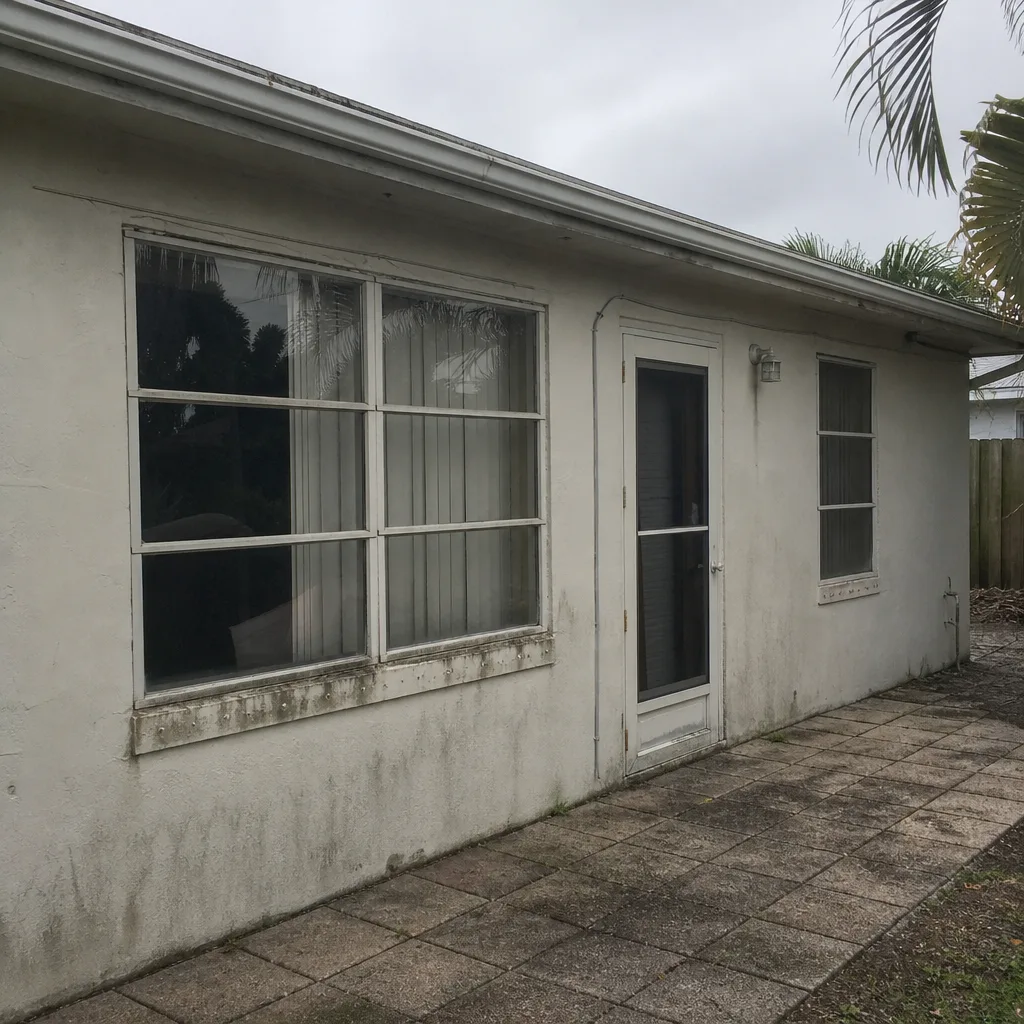 Before
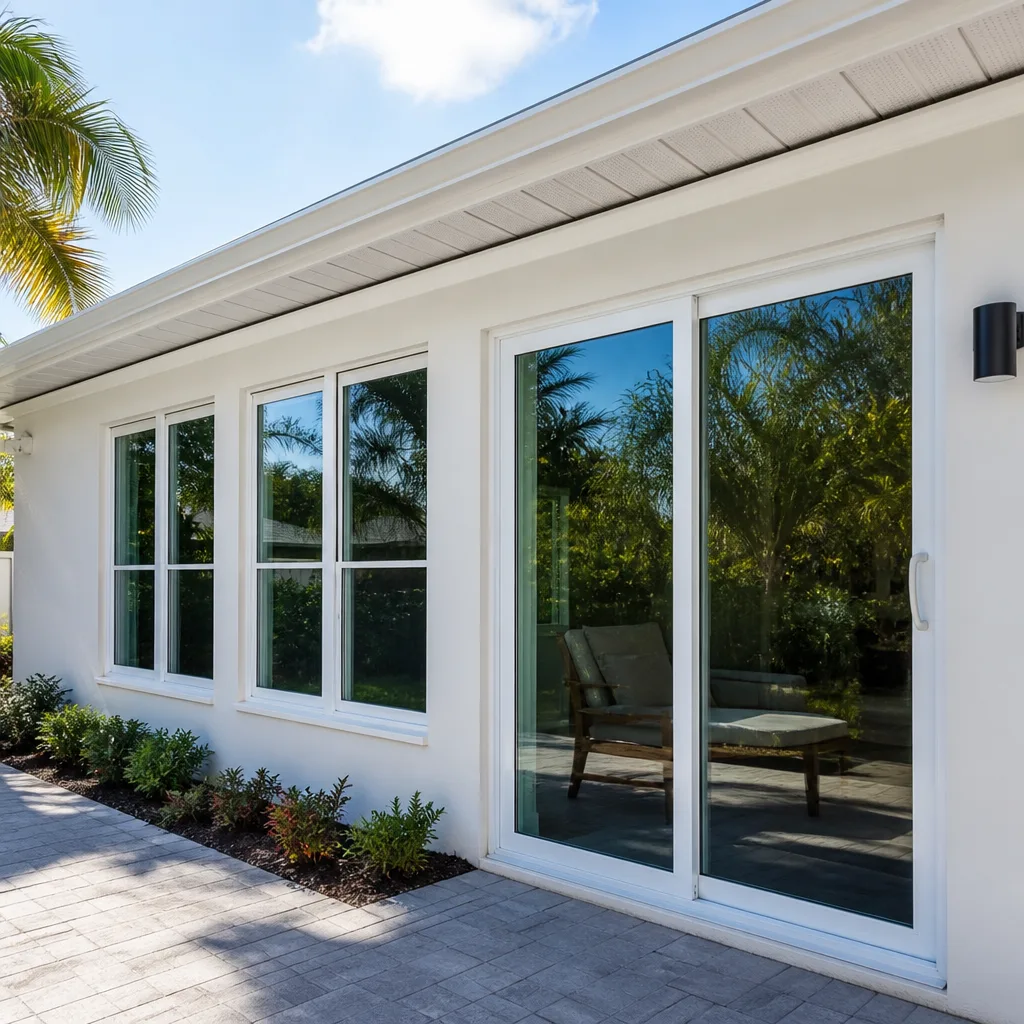 After
AfterTable of Contents
- How to Identify Sealed Unit Failure Before Condensation Appears
- The Dollar-Bill Drag Test: Measuring Weatherstripping Degradation
- Frame Corner Joint Separation in Aluminum Systems
- Threshold Measurement and Storm-Season Readiness
- Detecting Door Shift Off the Hinge Plane
- What Paint Bleeding Around Exterior Frames Reveals
- Go/No-Go: Owner-Manageable, Contractor, or Immediate Replacement
- Common Mistakes to Avoid
How to Identify Sealed Unit Failure Before Condensation Appears

Sealed unit failure in Pompano Beach follows a predictable sequence, and the visible fog between panes is actually the third stage, not the first. Understanding this sequence matters because stage-one intervention means replacing the insulated glass unit (IGU) only. Stage-three intervention often means replacing the entire window system plus addressing moisture damage to the rough opening.
Stage One: Desiccant Saturation
Every dual-pane window contains a desiccant strip in the spacer bar between the panes. This material absorbs the small amount of atmospheric moisture trapped during manufacturing. In Pompano Beach’s climate, with its combination of high humidity, salt air, and intense solar gain, the desiccant works harder than in inland markets. When the seal around the glass perimeter begins to degrade, ambient moisture enters faster than the desiccant can absorb it.
The first detectable sign is subtle: the glass surface feels slightly cooler to the touch on the interior pane during morning hours than adjacent windows in the same exposure. This happens because the low-E coating and argon gas that provide thermal resistance are degrading. The glass is beginning to function like single-pane.
Stage Two: Diurnal Cycling
As seal degradation continues, the moisture content inside the cavity fluctuates with daily temperature swings. You may notice a faint haze that appears in early morning and dissipates by midday. This is not condensation on the interior surface; it is moisture trapped between the panes that temporarily evaporates when solar gain warms the glass. In Pompano Beach’s east-facing windows, this pattern is often visible by 8:00 a.m. during fall and winter months when overnight lows drop into the sixties and morning sun rapidly heats the exterior pane.
Stage Three: Permanent Fog
Once the desiccant is fully saturated, moisture remains in the cavity continuously. The fog becomes permanent, and mineral deposits begin to etch the interior glass surfaces. At this point, the thermal performance of the window has degraded to approximately that of single-pane glass, and the structural integrity of the spacer bar may be compromised by corrosion.
Detection Method: The Flashlight Test
- Wait until one hour after sunset, when exterior and interior temperatures have stabilized.
- Turn off all interior lights in the room.
- Hold a flashlight at a 45-degree angle to the glass, shining across the surface rather than through it.
- Look for a faint iridescent sheen or micro-droplets on the interior of the outer pane. These indicate stage-two desiccant saturation.
- Repeat monthly on the same window to track progression.
In our experience across Pompano Beach installations since 2012, east and south exposures fail first due to thermal cycling stress. Windows protected by deep overhangs or awnings typically show 30-40% longer seal life. When we specify replacement IGUs for customers in neighborhoods like Cypress Bend or Palm Aire, we typically recommend upgrading to a warm-edge spacer system, which extends seal life in high-humidity markets by reducing thermal conduction at the glass perimeter.
Window Replacement in Pompano Beach becomes necessary when the frame system itself has been compromised by moisture ingress, not merely when the glass has failed. The measured survey we provide distinguishes between these conditions.
The Dollar-Bill Drag Test: Measuring Weatherstripping Degradation
Weatherstripping failure is the most common and least detected window and door defect in South Florida. The material degrades incrementally, and homeowners adapt to the gradual increase in air infiltration without recognizing the energy cost or the structural risk during storm events.
The Test Procedure
- Close and latch the window or door fully.
- Insert a standard U.S. dollar bill between the sash and the frame at the lock side, approximately midway up the opening.
- Close the latch without crushing the bill.
- Attempt to withdraw the bill with steady, moderate pressure.
If the bill slides out with minimal resistance, the weatherstripping compression has degraded below functional threshold. A proper seal requires approximately 30% compression of the weatherstripping material when the sash is latched. In Pompano Beach’s climate, compression-set degradation accelerates due to UV exposure and ozone concentration.
Quantifying the Leak
Repeat the test at four points: lock side, hinge side, head, and sill. Document the results:
- 0-1 points of failure: Weatherstripping is functional. Re-test annually.
- 2 points of failure: Localized degradation. Replace weatherstripping at failed points.
- 3-4 points of failure: Systemic degradation. The sash or door may be out of square, or the frame has settled. Requires professional inspection.
The energy impact is measurable. A window that fails the dollar-bill test at two points has an effective air leakage area roughly equivalent to a 2-inch diameter hole in the wall. In Pompano Beach’s cooling-dominated climate, with air conditioning running 2,800+ hours annually, this leak adds $80-$140 per year to a typical residential electric bill per failed window. For a home with six failed windows, the annual cost approaches $600-$840.
During tropical storm and hurricane season, degraded weatherstripping allows wind-driven rain to penetrate the pressure envelope. The water may not appear immediately inside; it often travels within the wall cavity, promoting mold growth and fastener corrosion before visible interior staining occurs.
Replacement weatherstripping must match the original profile precisely. Generic bulb seals from hardware stores rarely restore the designed compression ratio. When we specify Window Installation in Pompano Beach, we document the exact weatherstripping profile in the measured survey so that future replacement uses the correct material.
Frame Corner Joint Separation in Aluminum Systems

Aluminum window and door frames in Pompano Beach are predominantly assembled with mechanical corner joints: either screw-spline construction or knock-down (KD) corners with internal brackets. These joints are designed to accommodate thermal expansion, but they are not immune to separation under the specific stress conditions of coastal South Florida.
The Failure Mechanism
Corner joint separation begins with micro-movement at the joint interface. Salt air deposits chloride ions at the joint line. Thermal cycling expands and contracts the aluminum, working the joint incrementally. Sealant at the exterior joint line fatigues. Water enters the joint during wind-driven rain events, accelerates corrosion of internal fasteners, and the joint begins to gape.
This process precedes visible water infiltration by 6-18 months. Detecting it at the micro-movement stage prevents the cascade of frame degradation, sill rot, and interior drywall damage that follows.
The 15-Degree Light-Angle Inspection
- Choose an overcast day or early morning when direct sun does not create competing glare.
- Stand inside, approximately 24 inches from the window or door.
- Hold a flashlight or use a desk lamp positioned at 15 degrees to the plane of the frame, shining along the corner joint.
- Observe the corner where the vertical and horizontal frame members meet.
- Look for a hairline shadow line or light penetration at the joint interface. A sound joint shows no light penetration; the corner appears uniformly solid.
- Repeat at all four corners of each opening.
The 15-degree angle is critical. Perpendicular light washes out the micro-gap. Parallel light (along the frame face) may miss the separation if it is primarily in the joint’s depth dimension. The oblique angle reveals the gap’s three-dimensional geometry.
In Pompano Beach’s older housing stock, particularly the mid-century modern and ranch-style homes in neighborhoods like Collier Manor and Cresthaven, original aluminum windows from the 1960s-1980s are now reaching the end of their structural service life. The corner joints in these systems often show separation that is invisible to casual inspection but readily apparent under the 15-degree light test.
When joint separation exceeds 1/32 inch (approximately the thickness of a credit card edge), the frame’s structural integrity is compromised. The joint can no longer resist racking forces during wind events, and the glazing seal is under cyclic stress. Replacement is indicated. For separation between detectable and 1/32 inch, professional evaluation can determine whether joint remediation or full replacement is appropriate.
We document corner joint condition in our measured survey with close-range photography. The customer receives these images as part of the documented photo record standard under Haven Clause 4 (Evidence on every job).
Threshold Measurement and Storm-Season Readiness
The threshold is the most abused component of any door system and the most frequently neglected in maintenance planning. In Pompano Beach, with its sand particulate load, salt air, and intense rainfall, threshold degradation follows an accelerated curve compared to inland markets.
The Measurement Protocol
Threshold wear is not visible as a simple recession. It manifests as a complex profile change that compromises the door’s ability to seal against wind-driven rain. The critical measurement is the elevation differential between the threshold’s original datum and its current surface at three points: the latch side, the center, and the hinge side.
- Remove any threshold caps or covers to expose the substrate.
- Locate the manufacturer’s stamp or a point of original finish that indicates the as-built surface level. On many aluminum thresholds, this is the plane of the anodized finish that remains protected under the door sweep.
- Measure from this original datum to the current walking surface at the three specified points using a digital caliper or depth gauge.
- Record the maximum differential.
Interpreting the Measurement
- 0-1/16 inch: Normal wear. Maintain sweep and gasket contact.
- 1/16-3/16 inch: Accelerated wear. The threshold surface has eroded sufficiently that the door sweep no longer maintains consistent compression. Wind-driven rain penetration is likely during tropical storm conditions. Schedule replacement before next storm season.
- Exceeding 3/16 inch: Critical degradation. The threshold substrate may be compromised by corrosion or rot. Immediate replacement required. The door system cannot be considered storm-ready.
The 3/16-inch threshold is particularly important in Pompano Beach due to the Broward County amendment to the Florida Building Code that requires exterior doors in flood-prone areas to maintain a minimum threshold elevation relative to adjacent grade. A degraded threshold may fail this requirement even if the door assembly itself is structurally sound.
Sweep replacement alone does not restore threshold function when wear exceeds 1/16 inch. The sweep compresses to accommodate the profile change, but this reduces its available travel for sealing against irregularities and increases operating force. We have measured operating force increases of 40-60% on doors with compensating sweep adjustments, which stresses hinges and hardware prematurely.
For Door Installation in Pompano Beach, we specify thresholds with replaceable wear surfaces from manufacturers like Therma-Tru, which allow surface replacement without full threshold removal. This reduces lifecycle cost and maintains storm-readiness without the disruption of a full door replacement.
Detecting Door Shift Off the Hinge Plane
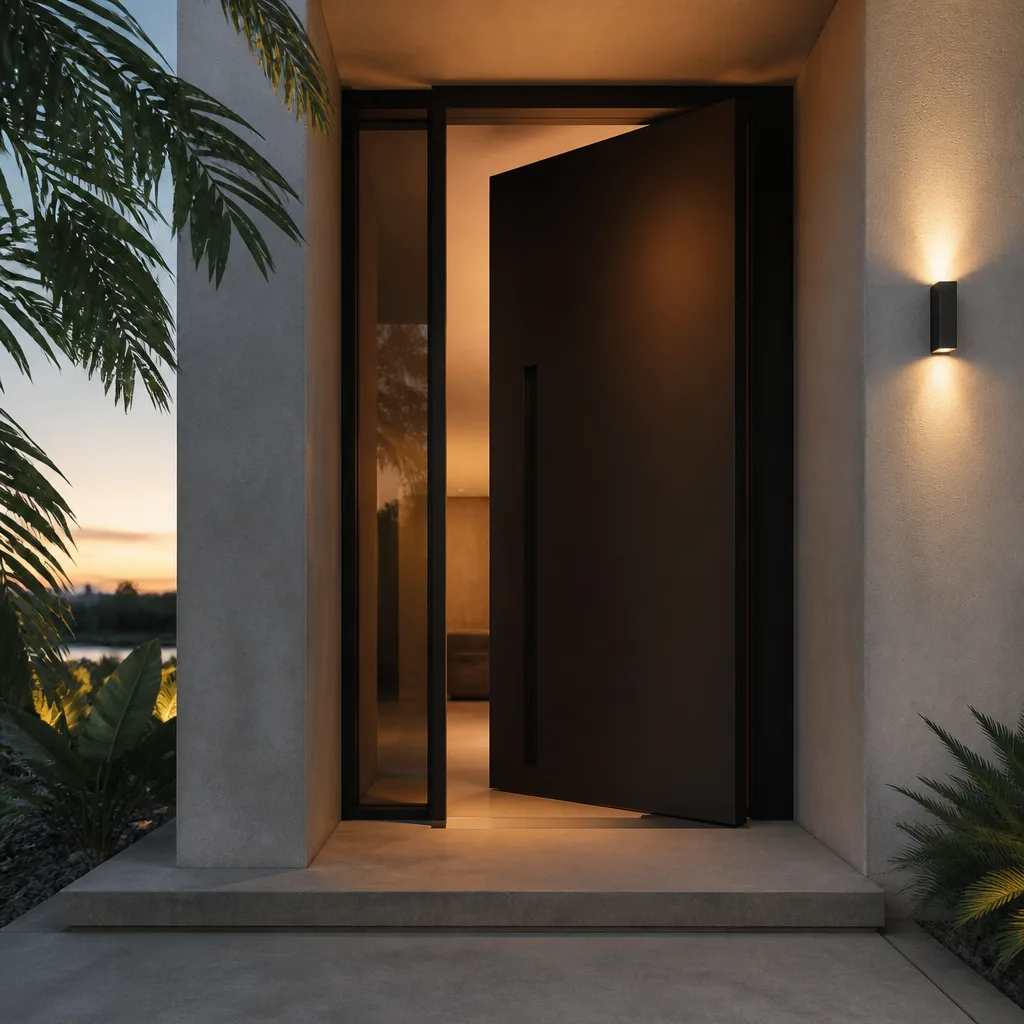
A door that “sticks” is not necessarily a door that has warped. In Pompano Beach’s coastal construction, frame movement is more common than slab warping, and the distinction determines whether the repair is adjustment (inexpensive) or replacement (significant).
The Sound Signature
A door operating correctly produces a consistent, muted percussion when latched: the strike plate receives the latch bolt with a solid, brief impact. A door that has shifted off its hinge plane produces a distinctively different sound: a hollow, slightly prolonged impact with possible rattle, as the latch bolt contacts the strike plate at an angle rather than perpendicular.
This sound change precedes visible sticking by weeks to months. Homeowners who recognize it can intervene before the misalignment damages the latch mechanism or the strike plate mortise.
Determining Frame Movement vs. Slab Warp
- Close the door until the latch just contacts the strike plate, without engaging.
- Measure the gap between the door edge and the jamb at the top, middle, and bottom of the latch side using feeler gauges.
- Record the three measurements.
- Open the door and measure the gap between the hinge side of the slab and the jamb at the same three elevations.
Interpretation:
- If the latch-side gap varies progressively (wider at top or bottom) while the hinge-side gap remains parallel, the frame has racked. This is common in Pompano Beach’s sandy soils, where minor settlement affects door frames before window frames due to their concentrated load path. Repair involves frame shimming and fastener correction.
- If both gaps vary, or if the hinge-side gap is parallel but the slab shows twist when sighted along its face, the slab has warped. Replacement is typically required, as wood and composite slabs rarely return to true.
- If the hinge-side gap has tightened progressively from top to bottom, the hinges have elongated their mortises or the jamb has compressed at the hinge locations. Hinge replacement with longer screws to structural framing may correct this.
The frame-racked condition is particularly common in Pompano Beach’s garden apartment and townhouse stock, where concrete slab-on-grade construction transmits minor settlement to door frames. In single-family construction, the condition often appears after re-roofing, when the added load of new shingles or tile causes slight compression of wall framing.
We include hinge-plane assessment in our measured survey, with plumb and level readings documented to 1/16 inch. The written scope specifies whether correction requires adjustment, component replacement, or full Door Installation in Pompano Beach.
What Paint Bleeding Around Exterior Frames Reveals
Paint failure around window and door frames is routinely misdiagnosed as a cosmetic issue requiring repainting. In Pompano Beach’s climate, specific patterns of paint degradation indicate substrate conditions that repainting alone will not correct and may conceal.
The Pattern Language
Three distinct paint failure patterns around exterior frames signal different substrate conditions:
Pattern A: Radial Cracking from Frame Edge
Fine cracks radiating outward from the frame perimeter into the stucco or siding indicate movement at the frame-wall interface. The frame is shifting relative to the wall substrate, breaking the paint film. This pattern is common in stucco-clad homes where the frame flange was not properly integrated with the lath system. The underlying condition is often a gap between frame and rough opening that allows water to bypass the flashing.
Pattern B: Blistering Concentrated at Sill
Blisters forming primarily along the horizontal sill member, sometimes with rust staining on light-colored paint, indicate capillary water migration up the frame from the sill pan. In Pompano Beach’s flat-slab construction, this often occurs when the sill pan was omitted or improperly sloped during original construction. The water source may be irrigation overspray, grade-level splash, or internal condensation draining to the sill.
Pattern C: Uniform Chalking with Substrate Exposure
Chalky degradation that exposes the substrate beneath, occurring uniformly around the frame perimeter, indicates that the substrate itself has failed. In wood-frame construction with stucco cladding, this typically means the water-resistant barrier behind the stucco has degraded, and the sheathing is absorbing moisture. The paint fails because it no longer has a sound substrate to adhere to.
The Probe Test
Where Pattern A or B is present, a non-destructive probe can assess substrate condition:
- Select an area of paint failure at the frame edge, away from visible structural components.
- Using a plastic putty knife (to avoid damaging substrate), gently lift the edge of the failed paint.
- Observe the material beneath. Sound substrate shows uniform color and firm texture. Degraded substrate shows discoloration, softening, or friable texture.
- If the substrate is soft to probe penetration beyond 1/8 inch, moisture damage extends behind the visible failure zone.
Pattern C always indicates substrate replacement. The extent cannot be determined from exterior observation alone; exploratory removal is required.
In Pompano Beach’s coastal environment, the salt air accelerates paint degradation on all substrates, but the rate of degradation from sound substrate versus failed substrate differs by a factor of 3-4. A frame with sound substrate and quality paint may show first maintenance needs at 7-10 years. A frame with concealed moisture damage may show complete paint failure in 2-3 years. The difference is diagnostic, not merely cosmetic.
When we encounter paint bleeding patterns during survey, we photograph the specific pattern and note the probable substrate condition in the written scope. The customer receives this documentation before any work authorization, under Haven Clause 1 (Have it in writing).
Go/No-Go: Owner-Manageable, Contractor, or Immediate Replacement
Not every warning sign requires the same response, as our DIY vs Professional Windows & Doors: The Pompano Beach Homeowner’s Decision Guide explores. Misallocating intervention level wastes money on unnecessary replacement or delays needed action until damage cascades. This framework assigns each condition to the appropriate response tier based on our experience with Pompano Beach installations since 2012.
| Warning Sign | Owner-Manageable | Contractor Inspection | Immediate Replacement |
|---|---|---|---|
| Stage-one seal failure (flashlight test positive, no visible fog) | Monitor monthly; document progression | Schedule if progression exceeds 3 months | Not indicated |
| Stage-two seal failure (diurnal fog) | Not applicable | Schedule within 30 days for IGU replacement assessment | If frame corrosion or interior moisture detected |
| Stage-three seal failure (permanent fog) | Not applicable | Not applicable | IGU replacement minimum; frame replacement if moisture damage confirmed |
| Weatherstripping: 0-1 failure points | Annual re-test; replace weatherstripping when 2 points fail | Not indicated | Not indicated |
| Weatherstripping: 2 failure points | Replace weatherstripping with correct profile | If sash appears out of square after replacement | Not indicated |
| Weatherstripping: 3-4 failure points | Not applicable | Schedule for frame squareness and structural assessment | If frame is racked beyond adjustment |
| Corner joint separation: detectable to 1/32 inch | Monitor quarterly with light-angle test | Schedule for joint remediation evaluation | Not indicated unless progression rapid |
| Corner joint separation: exceeds 1/32 inch | Not applicable | Not applicable | Frame replacement required |
| Threshold wear: 0-1/16 inch | Maintain sweep; re-measure annually | Not indicated | Not indicated |
| Threshold wear: 1/16-3/16 inch | Not applicable | Schedule replacement before next storm season | If substrate corrosion detected |
| Threshold wear: exceeds 3/16 inch | Not applicable | Not applicable | Immediate replacement; door may not be storm-ready |
| Door off hinge plane: frame racked | Not applicable | Schedule for frame shimming and hardware correction | If frame is structurally compromised |
| Door off hinge plane: slab warped | Not applicable | Confirm diagnosis; specify replacement | Slab replacement typically required |
| Paint Pattern A (radial cracking) | Not applicable | Schedule for flashing and interface inspection | If rough opening moisture damage confirmed |
| Paint Pattern B (sill blistering) | Correct irrigation grade; improve drainage | Schedule for sill pan inspection and remediation | If sill pan is absent and sheathing is damaged |
| Paint Pattern C (uniform chalking) | Not applicable | Not applicable | Substrate replacement required; extent determined by exploratory removal |
This framework assumes the homeowner has basic measurement tools: flashlight, dollar bill, feeler gauges, and digital caliper. The tests described require no specialized training, but they do require systematic documentation. We provide the measured survey as a baseline for customers who prefer professional documentation, but the framework functions independently for owner-managed monitoring. For more guides & resources, visit our blog.
Common Mistakes to Avoid
- Waiting for visible water damage. By the time interior drywall shows staining, the rough opening has typically been wet for 12-24 months. The repair scope expands from window replacement to wall assembly remediation. In Pompano Beach’s humidity, mold colonization begins within 48-72 hours of moisture intrusion.
- Applying silicone sealant over failing paint. This traps moisture behind the sealant, accelerates substrate decay, and makes future proper repair more expensive. Sealant is a finish detail, not a structural repair.
- Replacing weatherstripping with generic product. Bulb diameter, compression ratio, and retention geometry vary by manufacturer. Incorrect weatherstripping may appear to seal but fails under pressure differential during wind events. We specify exact profiles from ES Windows, ECO Window Systems, or Mr-Glass depending on the original system.
- Assuming new construction windows are maintenance-free. Even impact-rated systems from premium manufacturers require annual inspection of weep holes, track drainage, and hardware torque. Salt air deposits require periodic rinsing of exterior hardware to prevent corrosion.
- Ignoring threshold maintenance in garage door systems. The threshold seal on an impact-rated garage door is part of the pressure envelope. Degradation compromises the entire home’s wind-load resistance, not merely the garage interior. We inspect threshold condition on every impact garage door service call.
- Accepting verbal estimates for window or door work. Without a written scope tied to measured dimensions, the quoted price and final invoice diverge predictably. Haven Clause 1 exists because this divergence is routine in the industry, not exceptional.
- Failing to document pre-existing condition before storm season. Insurance claims for window and door damage require evidence of pre-storm condition. The documented photo record we provide on every visit serves this function, but homeowners can achieve basic documentation with dated photographs of each opening.
When to Call a Professional

Call a professional-see How to Hire a Windows & Doors Contractor in Pompano Beach: A Step-by-Step Guide-when any condition in the Immediate Replacement tier of the decision framework is present, when contractor inspection conditions show progression between quarterly checks, or when you lack confidence in your own assessment. The cost of professional evaluation is minor compared to the cost of deferred intervention.
Sightline Windows & Doors Pompano Beach offers free estimates in Pompano Beach. Every estimate includes the measured survey you keep, the written scope with line-item pricing, and the documented photo record of existing conditions. Our technicians are background-checked, uniformed, and identified by license number before arrival, under Haven Clause 3 (Verified Crews). The written price we provide before any work starts is the same price on the final invoice, under Haven Clause 1. If the work is not done right, we make it right under the 365-Day Done Right Promise, written into the Haven Standard since 2012.
Call (754) 253-0713 to schedule your free estimate.
Frequently Asked Questions
Early-stage IGU replacement typically runs $180-$340 per opening for standard sizes, while delayed intervention requiring full frame replacement plus wall remediation often exceeds $800-$1,400 per opening. The cost multiplier for late detection is 4-5x in Pompano Beach’s market due to labor rates and the prevalence of stucco cladding that requires matching repair. Call (754) 253-0713 for an exact quote on your specific openings - estimates are free.
No. Haven Clause 1 states that the measured survey and the written quote are the same document. The price cannot change unless the scope changes, and any scope change requires written authorization before work proceeds. This has been Sightline’s practice since 2012.
Yes. Permits are required for all window and door replacements that alter the opening size or change the product type, and for any impact-rated installation. We pull permits, schedule inspections, and ensure code compliance as part of the written scope. The permit status is documented in the photo record.
A standard retrofit replacement in Pompano Beach requires 4-6 hours per opening for a crew of two, assuming no substrate remediation. Full-frame replacement with stucco repair extends to 1-2 days per opening. We specify the expected duration in the written scope before work authorization.
Sometimes. If the frame is sound and the IGU is a standard size, glass-only replacement is feasible. However, many older Pompano Beach homes have discontinued frame systems or custom IGU dimensions that make glass-only replacement impractical. The measured survey determines which path applies.
Impact-rated windows carry a permanent label indicating compliance with ASTM E1886/E1996 or Miami-Dade County Protocol PA 201/202/203. The label is typically located on the frame edge or sash rail. If no label is present, the window is not impact-rated. In Pompano Beach’s wind-borne debris region, non-impact windows require shutter protection for code compliance. We verify rating status during our measured survey and document it in the written scope.
The Bottom Line
Window and door failure in Pompano Beach is predictable and detectable at early stages with simple, low-cost tests. The flashlight test for seal failure, the dollar-bill drag test for weatherstripping, the 15-degree light-angle inspection for frame joints, threshold measurement, hinge-plane assessment, and paint pattern recognition form a complete early-warning system. Intervention at these early stages typically costs 20-25% of deferred replacement. The conditions that require immediate action are specific and identifiable: permanent fog between panes, corner joint separation exceeding 1/32 inch, threshold wear beyond 3/16 inch, and uniform paint chalking indicating substrate failure. Everything else falls into a monitor-or-inspect tier that allows planned, budgeted response rather than emergency expenditure.
Written by Sonia Raman, Owner at Sightline Windows & Doors Pompano Beach, serving Pompano Beach since 2012.
Six Reasons Homeowners Choose Sightline Windows & Doors Pompano Beach
Impact systems engineered to design pressures up to +/-100, matched to your wind zone - your openings hold when the storm arrives.
Low-E insulated impact glass from our manufacturer lines commonly cuts monthly cooling bills 20-30%.
Laminated impact glass shuts out up to 40% of outside noise - traffic, neighbors, weather.
Monitoring services run $30-90 a month. Laminated impact glass resists forced entry around the clock, with no subscription.
Florida homeowners average around 25% savings on the windstorm portion of their policy after protecting every opening - some homes qualify for more.
A full impact package upgrades curb appeal, buyer confidence and appraised value in one project.
Other Sightline Windows & Doors Pompano Beach Services